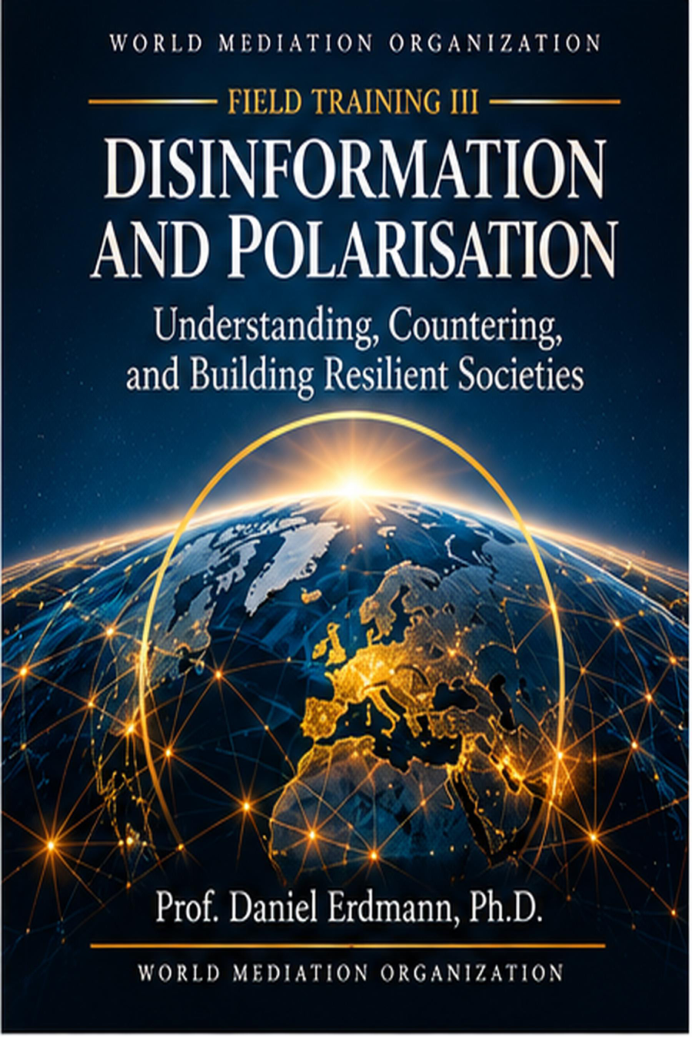
Volume III
Disinformation and Polarisation
Two hundred people forwarded a video to their neighbours because they thought it might matter. Nobody lied. A town came apart anyway.
Most training on this subject teaches you to spot fakes. That is the easy half, and it is not where the damage happens.
One hundred and thirty seven pages. Six chapters. Fifty hours of work. Written by the founder of the World Mediation Organization.
EUR 390 · self study · begin today
The Problem, Stated Plainly
Two sides no longer disagree about what should happen. They disagree about what happened, with dates.
You cannot negotiate a shared future between parties holding incompatible accounts of last Tuesday. And you cannot fix it by producing evidence, because your evidence arrives inside the same contested space and is read as one more move.
This training is about that space: how narratives move, how a community stops sharing facts, what the research actually supports, and what a person can do in a district on a Tuesday with no budget.
What You Actually Get
Six chapters of roughly twenty pages, delivered as a book rather than as a slide deck.
One. How Narratives Move. Misinformation, disinformation and malinformation, and why each needs a different response. Why repetition raises perceived truth even in people who know better. The five stages of a claim, and the four roles that move it, including the one nobody names.
Two. The Techniques. Actors, behaviour and content sorted separately. Six content techniques, of which the two most effective alter nothing and invent nothing. How to tell a campaign from a crowd, and why calling a crowd a campaign is the worse mistake.
Three. Polarisation. Why two groups can converge on what they want while growing unable to sit together. Crosscutting institutions as the measurable form of resilience. And the perception gap, which is the cheapest useful thing anybody can do in a divided town.
Four. Detection. Establishing what is true in ninety minutes with a browser and a telephone. Provenance, lateral reading, images, video, accounts, numbers. Including the claim that has no image, which is the ordinary case.
Five. What Works. The honest evidence on correction, inoculation, messengers and conversation. What reliably fails, listed plainly. And the three windows, only one of which is ever used.
Six. Local Practice. The room with fourteen chairs. Finding the people others check with. Giving an existing body something real to decide. And what this work does to the people who do it for years.
The Fifty Hours
We publish what the work consists of, because a number on its own means nothing.
| Component | Hours |
|---|---|
| Reading the six chapters | 7 |
| Twelve required readings, named in the chapters, all freely available | 16 |
| Six exercises, done on material you find yourself | 4 |
| Sixty questions with immediate answers, ten per chapter | 3 |
| Six written analyses, one per chapter | 18 |
| A final assignment: a full assessment of one contested information space | 6 |
| Total | 54 |
We publish fifty rather than fifty four so that the figure holds even if you work faster than we expect. The reading is the portion any library could have given you. The eighteen hours of writing are the portion it could not.
Who This Is For
For anybody working where the facts themselves are contested. Staff of agencies and international organizations. Local administrators and elected representatives. Journalists and editors. Programme leaders in unstable regions. Teachers and school leaders. Researchers, and students of communication and conflict.
And for practitioners who have watched a careful correction change nothing and want to understand why.
No prior qualification is required, and no membership.
What Makes It Different
It teaches psychology, not tool use. A thread runs through all six chapters and begins with the reader rather than with anybody else: your own susceptibility, whether you are reasoning or defending, whom you believe and why, what it costs to be the person who checks, what you are actually asking of somebody, and the contempt this work produces if you let it.
It is honest about weak evidence. This is a young field full of confident claims. Where the research is solid we say so. Where the popular account is wrong, which is often, we say that too, with the names of the people who established it.
It ends where the outcome is decided. Not with detection, which is the tractable part, but with the room containing fourteen people, the institution that has stopped meeting, and the question nobody has answered.
It runs on one town. Sixty thousand people, forty seconds of real footage from somewhere else, and five people who saw the same video and drew completely different conclusions, followed from the first evening to eighteen months later.
What It Is Not
It is not the WMO certification. It carries no title and produces no entry in the Mediators Directory. Nothing you submit is read by a person, because nothing is submitted.
It is also not a tools course. We name no software, because detection tools expire as generators improve, and everything taught here works with a browser and a telephone in ten years’ time.
What you receive is a Statement of Completion, issued the day you finish, recording the training and its hours. Complete all six Field Trainings and the house issues a Certificate of Completion for the series, recording some eight hundred and eighty pages and not fewer than three hundred hours.
Price and Terms
EUR 390. The same fee in every country in the world. Paid once, no subscription.
Access for twelve months. Study in any rhythm and any time zone. Begin the day you pay.
The fee is credited once against the Expert Training if you book within twelve months.
Questions People Actually Ask
Do I need to take Volume I first? No. Each training stands alone. Reading a Conflict teaches the analysis this one assumes, so many people take it first, and nothing here requires it.
Will this teach me to detect deepfakes? It will teach you why detection tools decay and what to do instead, which is to establish where something first appeared. That question is answerable in ninety minutes and does not expire.
Is this about social media? Partly. Much of what damages a town moves in closed messaging groups between people who know each other, and no algorithm built those. The chapter on polarisation explains why the sealed bubble is a poor description of what is happening.
Is there an examination? No, and no tutor and no deadlines. Each chapter carries ten questions with the answers printed beneath them, asking you to apply the chapter rather than recall it. Nothing is scored and nothing is recorded.
Do I need a case to work on? Yes, and you choose it in the first chapter: one contested information space connected to a place or group you know and are not professionally responsible for. You carry it through all six chapters.
Fifty hours, really? Seven hours of reading and forty seven of work, set out above. Read the chapters and do none of it and you will finish in an evening. Our system cannot tell the difference and will issue the statement either way, which we say plainly.
Is there a discount? No. One price everywhere, and no sales.
Falsehood is rarely the first thing to go wrong in a place. What goes wrong first is that a community loses every reliable way of settling anything together.
EUR 390 · 137 pages · Statement of Completion the same day