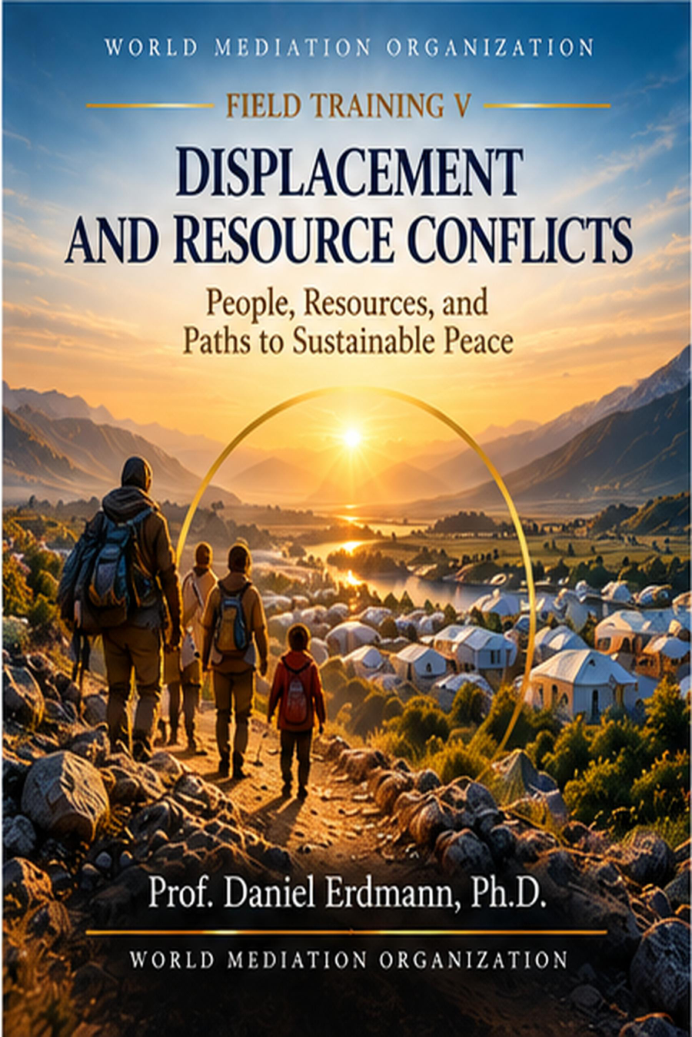
Volume V
Displacement and Resource Conflicts
A fence goes up four hundred kilometres away. Two years later somebody is killed at a borehole queue.
Fifty hours on land, water, movement and the people who arrive. What actually drives these conflicts, what repeats across continents, and what a practitioner can do that lasts after he has gone.
The Problem, Stated Plainly
This is the subject on which the most confident things are said and the least is known.
Scarcity causes conflict. Climate drives displacement. Water will cause the next war. Each of those sentences appears in briefings every week, each is either wrong or too loose to act on, and a practitioner who arrives carrying them will describe a district accurately in the vocabulary of his own sector and will not see the fence, the shifted calendar, the transferred official or the failing pump.
The evidence says something different and considerably more useful. Environmental change appears in the first of four links, and three human links follow before anybody is killed. States sharing rivers cooperate far more than they fight. Prices move conflict on a scale of weeks while rainfall moves it on a scale of seasons. And the arrangement that failed, in a nameable year, for a reason with an author, is almost always the thing that matters.
This training teaches the chain rather than the slogan, and then teaches what to do about it.
What You Actually Get
Six chapters, 160 pages, and a running case you carry from the first page to the last.
Chapter One takes the driver statement apart: the four links, the four resources and their four different logics, what the climate literature does and does not support, and the point at which a material dispute acquires an identity and a word.
Chapter Two is the patterns. Farmer and herder, upstream and downstream, extraction, resettlement, arrival, return, and the kinds of movement, including the one nobody plans for and the one where nobody is the author at all.
Chapter Three is displacement itself: the order that forms inside a settlement, the four kinds of authority and the one the organogram never shows, what distribution manufactures, and the second generation.
Chapter Four maps the actors, including the ones who are never in the room, and puts you on the map alongside them.
Chapter Five is what can actually be managed: the difference between an agreement and an arrangement, the six questions any arrangement must answer, and the six things that reliably fail.
Chapter Six is the conduct of the person doing the work: access, promises, movement, writing when the finding is unwelcome, leaving, and what a career in this does to somebody.
Throughout, a thread on field method: the question you ask first, holding a pattern without forcing it, what a conversation costs the person having it, your own position on the map, designing what you will not maintain, and the record you keep for yourself.
The Fifty Hours
Twelve required readings, at roughly three hours per chapter. Ostrom, Homer Dixon, Cernea, Unruh, Lischer, Betts, Autesserre, Arjona, Menkhaus, Anderson, and the evidence on climate and conflict from both sides of that argument.
Sixty questions with the answers, answered before you look. Six exercises of ninety minutes to two hours, each on a setting you choose and carry through the volume. Six written analyses that nobody reads but you. And a final assignment of two to three thousand words that draws the whole of it together.
Nothing is submitted. Nothing is scored. The work is yours and so is the honesty of it.
Who This Is For
Anybody working where land, water, pasture or movement is contested: mediators and conflict advisers, programme staff in displacement and resource settings, local authority officials, researchers, and the national staff who hold the institutional memory that this sector routinely treats as support.
It assumes no prior training in this subject and no fieldwork. It assumes you are prepared to write things down and to find out later that you were wrong.
What Makes It Different
It begins from what the evidence supports rather than from what is said at conferences, and it names the claims it removes.
It works at district scale, where these conflicts actually are, rather than at the level of states and treaties, where they are usually discussed.
It treats the receiving community as a party with losses and no forum rather than as the context in which a displaced population is assisted.
It is explicit about what a practitioner cannot do, which is most of what programme documents promise, and specific about the narrow set of things he can.
And it asks you to write a dated, falsifiable prediction and to go back and check it, which is the only quality control available in a field where almost nobody finds out whether they were right.
What It Is Not
It is not a certification and confers no title. It is a statement of completed study, issued in your name, and it does not entail entry in the WMO Mediators Directory.
It is not a course in humanitarian programming, in water engineering, or in international law, although it will tell you when each of those is the thing actually needed.
It is not a set of tools that transfer between places. The fifth chapter explains at length why the arrangement that has held for eleven years in one valley must not be turned into a model.
And it is not a method for resolving resource conflicts, because that is not available to anybody arriving from outside, and a training that promised it would be lying to you in the first paragraph.
Price and Terms
EUR 390. The same fee in every country in the world. Paid once, no subscription.
Access for twelve months. Study in any rhythm and any time zone. Begin the day you pay.
The fee is credited once against the Expert Training if you book within twelve months.
Questions People Actually Ask
Is this relevant if I work in Europe? Yes, and the volume makes the argument rather than assuming it. Arbitration, works councils, professional disciplinary bodies and families settle a large share of European disputes outside the courts, and every uncomfortable question this training asks of a council of elders can be asked of those.
Do I need to take the earlier volumes first? No. Each training stands alone and assumes nothing.
Which traditions are covered? Twelve scholars the volume rests on: Ostrom on the commons, Homer Dixon on the forms of scarcity, Cernea on the eight impoverishment risks of resettlement, Unruh on tenure after conflict, Lischer on when displacement spreads violence, Betts on what changes when people may work, Autesserre on the culture of intervention, Arjona and Mampilly on armed groups as authorities, Menkhaus on governance where the state does not return, Anderson on doing no harm, and the climate and conflict evidence argued from both sides.
Will it teach me a method I can use? It will teach you to establish what a method rests on before you move it, which is the skill that decides whether anything you use will work. It also sets out one element worth taking into any practice, and says plainly why the others are not available.
Is there an examination? No, and no tutor and no deadlines. Each chapter carries ten questions with the answers printed beneath them, asking you to apply the chapter rather than recall it.
Do I need a place to work on? Yes, and you choose it in the first chapter: somewhere procedures exist that are not those of the state, which may be somewhere you have worked, expect to, or know well. You carry it through all six chapters.
Is there a discount? No. One price everywhere, and no sales.
Ask what changed and when, before you ask what the problem is.
Fifty hours. One district you carry from beginning to end.
EUR 390, credited once against the Expert Training if you book within twelve months.