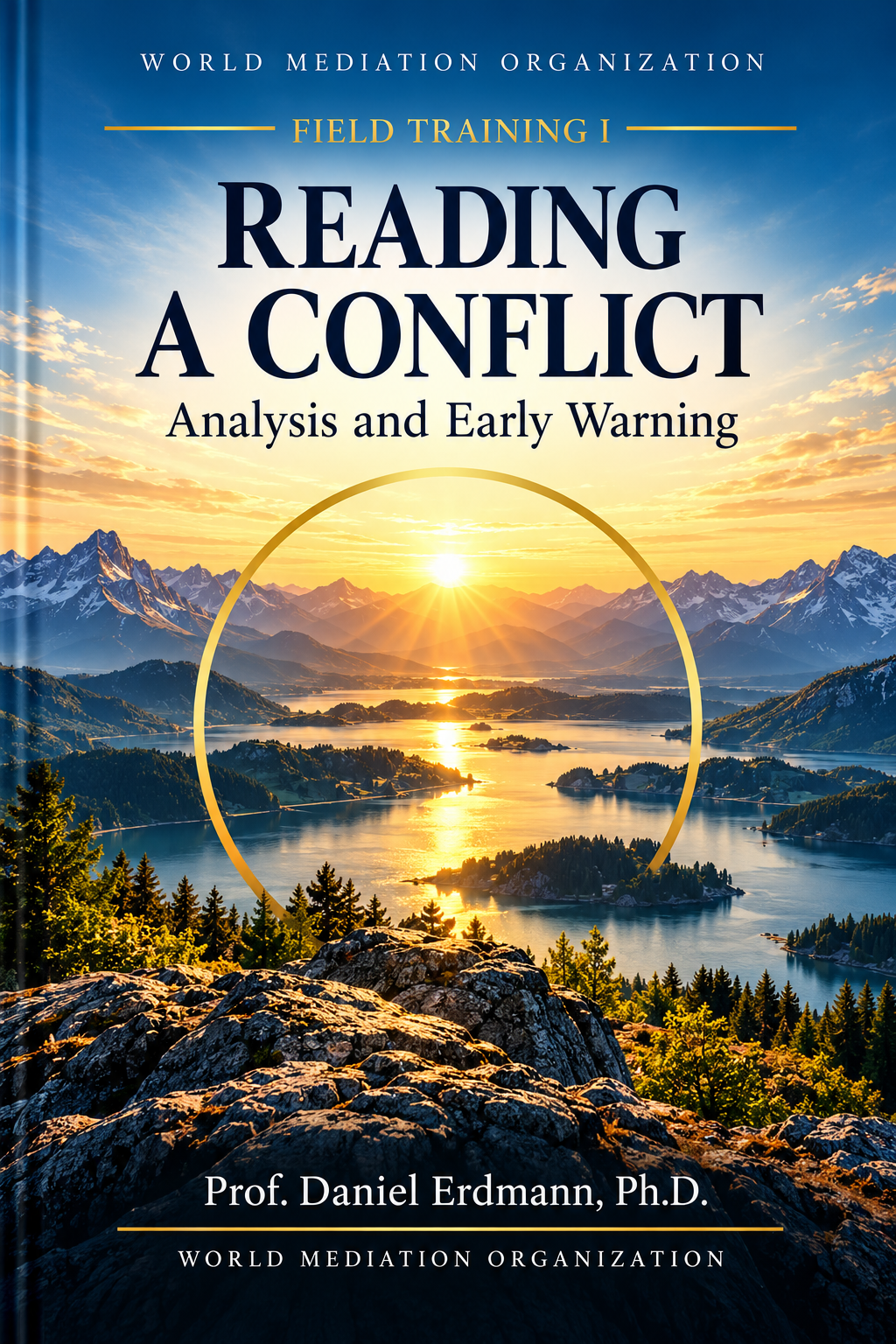
Volume I
Reading a Conflict
Before anyone can act in a conflict, somebody has to read it correctly. Most interventions fail long before they begin.
The parties were counted wrongly. The story was started on the wrong day. And nobody asked the one person who had already settled the same matter twice.
One hundred and thirty two pages. Six chapters. Fifty hours of work. Written by the founder of the World Mediation Organization.
EUR 390 · self study · begin today
The Problem, Stated Plainly
A folder lands on your desk on Monday. The answer is wanted by Friday.
Inside are two reports written somewhere else, a map with two boxes on it, and a recommendation with a budget already approved beside it.
The most important decision you will make all week happens in the first hour, and it is not a decision about method. It is a decision about what kind of thing is in that folder, and whether the account everybody in the room believes has ever been checked by anybody.
What You Actually Get
Six chapters of roughly twenty pages, delivered as a book rather than as a slide deck.
One. Not a Disease but a Condition. Conflict, dispute, crisis, violence: four words our trade uses interchangeably, each calling for a different answer on Monday. And why a resolved dispute so often leaves the conflict exactly where it was.
Two. Who Is Actually in It. Four rings of actors, including the party that denies being one and the institution already doing the work. What each side actually wants as against what it announces. Power read four ways, and the question of who can really commit a group.
Three. Why It Climbs. The nine stages and the two thresholds that matter. The five mechanisms that lift a conflict when nobody decided to climb. Who profits from continuation, tested actor by actor.
Four. Whether It Can Be Worked Today. I. William Zartman’s question, and the one our field asks last: can this be worked at all this year? The stalemate that must hurt both sides, the exit that must be believed, and what to do when the honest answer is no.
Five. Seeing It Before It Arrives. What reliably precedes violence, how to build an indicator set that survives past the second month, and the uncomfortable record of accurate warnings that changed nothing.
Six. One Page, Ninety Seconds. One page, eight sections, ninety seconds. How description, interpretation and judgement are kept visibly apart, and why the section listing what you do not know is the one that makes the rest believable.
The Fifty Hours
We publish what the work consists of, because a number on its own means nothing.
| Component | Hours |
|---|---|
| Reading the six chapters | 7 |
| Twelve required readings, named in the chapters, all freely available | 16 |
| Six exercises, done on a conflict you choose yourself | 4 |
| Sixty questions with immediate answers, ten per chapter | 3 |
| Six written analyses, one per chapter | 18 |
| A final assignment: a complete conflict brief with its annexe | 6 |
| Total | 54 |
We publish fifty rather than fifty four so that the figure holds even if you work faster than we expect. The reading is the portion any library could have given you. The eighteen hours of writing are the portion it could not.
Who This Is For
For anyone who has to form a judgement about a conflict before doing anything else with it. Staff of agencies and international organizations. Local administrators. Diplomats and desk officers. Journalists who want the analysis underneath the reporting. Project leaders working in unstable regions. Researchers and students of the discipline.
And for practitioners who already have a good instinct and want a structure underneath it, which is a different thing from learning one from scratch and is frequently harder.
No prior qualification is required, and no membership.
What Makes It Different
It teaches the question nobody asks first. Whether a conflict can be worked at all this year, before any method is chosen. A whole chapter, on I. William Zartman, whose work answers it and who is almost entirely absent from practitioner training.
It teaches evidence, not just frameworks. Every statement you write carries one of four weights: established by record, established by independent accounts, asserted by a party, or inferred by you. Applied sentence by sentence, that single discipline will change your writing more than any model.
It runs on one town. A municipality with a returned population, a mining concession and a postponed vote, seen through the eyes of five people who read the same events completely differently, and followed from the first classification to the finished brief.
It ends in a document. Not a framework and not a feeling. One page, eight sections, that somebody with ninety seconds in a corridor can actually use.
What It Is Not
It is not the WMO certification. It carries no title and produces no entry in the Mediators Directory. Nothing you submit is read by a person, because nothing is submitted.
What you receive is a Statement of Completion, issued the day you finish, recording the training and its hours. Complete all six Field Trainings and the house issues a Certificate of Completion for the series, recording some eight hundred and eighty pages and not fewer than three hundred hours.
When you want the formation with examination, written feedback, and a certificate that anybody can verify against a public register, that door is the Expert Training, and this fee comes off it within the year.
Price and Terms
EUR 390. The same fee in every country in the world. Paid once, no subscription.
Access for twelve months. Study in any rhythm and any time zone. Begin the day you pay.
The fee is credited once against the Expert Training if you book within twelve months.
Questions People Actually Ask
Which volume should I start with? This one. It teaches the reading that the other five assume you already have.
Is this theory? Every chapter ends in something you produce: a classification, a map, a stage judgement, an indicator card, a brief. The theory is there because a method without one cannot be applied to a situation nobody has written about yet.
Do I need a conflict to work on? Yes, and you choose it in the first chapter. Any conflict running now that you are not professionally involved in. You carry it through all six chapters.
Is there an examination? No, and no tutor and no deadlines. Each chapter carries ten questions with the answers printed beneath them, asking you to apply the chapter rather than recall it. Nothing is scored and nothing is recorded.
Fifty hours really? Seven hours of reading and forty seven of work, set out above. Read the chapters and do none of it and you will finish in an evening. Our system cannot tell the difference and will issue the statement either way, which we say plainly.
Does it certify me? No. A house that issued titles for self study would be worth nothing to the people who hold its real ones.
Is there a discount? No. One price everywhere, and no sales.
Conflicts are not misunderstood for lack of goodwill. They are misunderstood because nobody checked the account everybody believed.
EUR 390 · 134 pages · Statement of Completion the same day