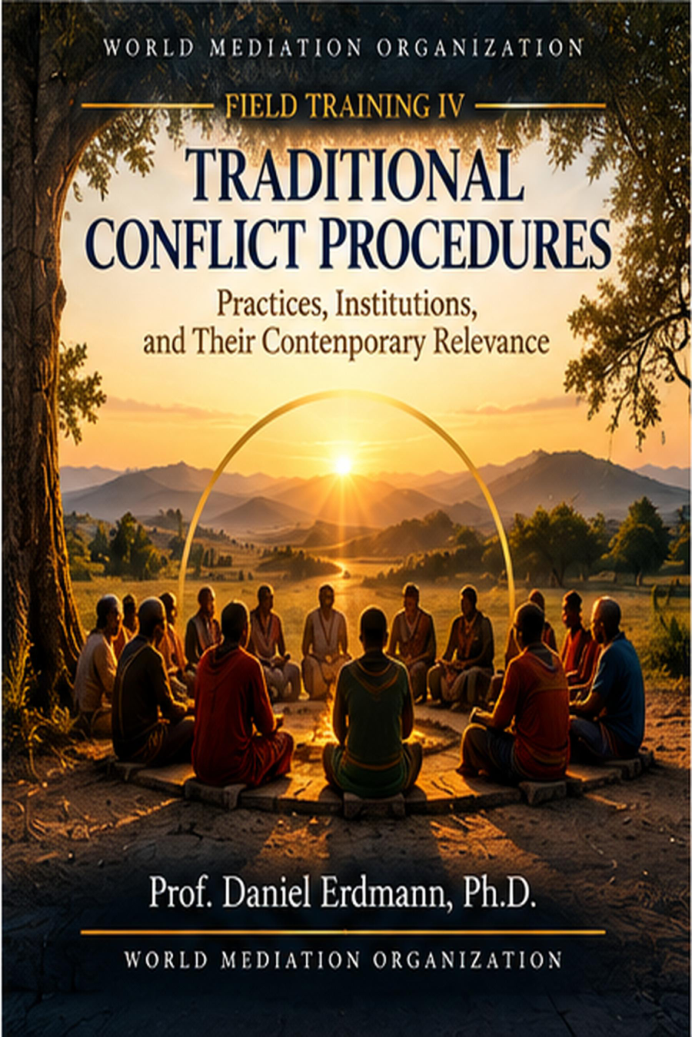
Volume IV
Traditional Conflict Procedures
In most of the world, most disputes are settled by people who have never heard of our profession, in procedures older than our institutions, that work.
A programme arrives in a district and establishes a community dispute mechanism. Eighteen months later it has held four hundred sessions. The five men who actually settle things in that district were in the room at the launch, and nobody asked them anything.
One hundred and sixty pages. Six chapters. Fifty hours of work. Written by the founder of the World Mediation Organization.
EUR 390 · self study · begin today
The Problem, Stated Plainly
We would never advise on a health system without establishing which clinics exist. We advise on dispute settlement, constantly, without establishing what settles disputes.
The court is four hours away, costs more than the matter is worth, and takes three years. So the population settles its quarrels elsewhere, through whatever it has. That arrangement is invisible to a visitor, has no building and no register, and is doing the work.
This training is about recognising it, describing it without judging it, knowing what may be used and what may not, seeing who it fails, and standing beside it without breaking it.
What You Actually Get
Six chapters of roughly twenty five pages, delivered as a book rather than as a slide deck.
One. Why This Matters Now. What is already operating where you have arrived, and six questions that establish it in two days, none of which uses the word traditional. Legal pluralism, the history that produced what you are looking at, and the two errors that ruin most work on this subject.
Two. The Common Architecture. Six elements that recur in societies that never met each other, and why that is engineering rather than heritage. Including how a settlement is made final without any power to enforce it, which is the property our own procedures cannot produce.
Three. The Regions. Twelve documented cases, arranged not by region but by what has happened to each: those in continuity, those a state took inside itself, those revived after decline, those asked to carry mass violence, and those disputed by their own societies.
Four. What Travels. Which elements can be used elsewhere, which cannot, and where borrowing becomes taking. Including the case of two parties who bring different understandings of what a proceeding is, which is now the ordinary case.
Five. The Uncomfortable Questions. Who these procedures fail, what consent means when refusal is expensive, who decides what would restore an injured party, and the rights argument given at full strength on both sides.
Six. Working Alongside. The first month, the first conversation, where to sit, what is worth offering, and when withdrawal is the contribution.
The Fifty Hours
We publish what the work consists of, because a number on its own means nothing.
| Component | Hours |
|---|---|
| Reading the six chapters | 7 |
| Twelve required readings, named in the chapters, all freely available | 16 |
| Six exercises, done on a place you choose yourself | 4 |
| Sixty questions with immediate answers, ten per chapter | 3 |
| Six written analyses, one per chapter | 18 |
| A final assignment: a full account of one procedure and what it would cost to work alongside it | 6 |
| Total | 54 |
We publish fifty rather than fifty four so that the figure holds even if you work faster than we expect. The reading is the portion any library could have given you. The eighteen hours of writing are the portion it could not.
Who This Is For
For anybody who works where the state is not the operative system. Staff of agencies and international organizations. Programme designers and evaluators. Local administrators and elected representatives. Lawyers working in plural jurisdictions. Researchers and students of anthropology, law, and conflict.
And for practitioners in Europe and North America who have begun to notice that their own societies settle most disputes outside their courts, and that the vocabulary for it does not exist at home.
No prior qualification is required, and no membership.
What Makes It Different
It is comparative rather than regional. Nobody else sets these traditions beside one another and asks what they share. That comparison is what produces the six elements, and the six elements are what let you read a procedure you have never encountered, in a society you know nothing about.
It refuses both of the usual positions. Not that customary procedure is inherently wise, which is patronising and ignores who is excluded. Not that it is a deficit awaiting proper institutions, which is empirically wrong about most of the world. These are institutions made by people, and they are treated as such.
It is honest about what cannot be taken. Chapter Four names the elements that can be moved and the ones that cannot, including the one every reader will want, and explains why wanting it is the wrong question.
And it ends with conduct rather than with design. The last chapter is about how a person behaves across weeks and months beside something he did not build, cannot control, and has no authority over.
What It Is Not
It is not the WMO certification. It carries no title and produces no entry in the Mediators Directory. Nothing you submit is read by a person, because nothing is submitted.
It is also not an anthropology course. Every case is set out with its sources named, and the purpose throughout is what a practitioner does on a Tuesday in a district, not what a discipline has concluded.
And it does not pretend to be a first hand account. This edition is built from the published scholarship, which the foreword says on its first page. The house is conducting its own recorded interviews with people who carry these procedures, and when enough exist they will replace and extend the third chapter in a second edition.
What you receive is a Statement of Completion, issued the day you finish, recording the training and its hours. Complete all six Field Trainings and the house issues a Certificate of Completion for the series, recording some eight hundred and eighty pages and not fewer than three hundred hours.
Price and Terms
EUR 390. The same fee in every country in the world. Paid once, no subscription.
Access for twelve months. Study in any rhythm and any time zone. Begin the day you pay.
The fee is credited once against the Expert Training if you book within twelve months.
Questions People Actually Ask
Is this relevant if I work in Europe? Yes, and the volume makes the argument rather than assuming it. Arbitration, works councils, professional disciplinary bodies and families settle a large share of European disputes outside the courts, and every uncomfortable question this training asks of a council of elders can be asked of those.
Do I need to take the earlier volumes first? No. Each training stands alone and assumes nothing.
Which traditions are covered? Twelve cases, including sulha, the jirga, West African councils, Hawaiian and Melanesian practice, the statutory systems of the Philippines and China, village arbitration in South Asia, Navajo peacemaking, peacemaking circles, gacaca and mato oput. Each with its sources named and its disputes stated.
Will it teach me a method I can use? It will teach you to establish what a method rests on before you move it, which is the skill that decides whether anything you use will work. It also sets out one element worth taking into any practice, and says plainly why the others are not available.
Is there an examination? No, and no tutor and no deadlines. Each chapter carries ten questions with the answers printed beneath them, asking you to apply the chapter rather than recall it.
Do I need a place to work on? Yes, and you choose it in the first chapter: somewhere procedures exist that are not those of the state, which may be somewhere you have worked, expect to, or know well. You carry it through all six chapters.
Is there a discount? No. One price everywhere, and no sales.
Before you propose anything, ask what is already there. It costs a day. And if you cannot answer by the end of it, you do not yet know enough to design anything, whatever your terms of reference say.
EUR 390 · 161 pages · Statement of Completion the same day